

From the Editor
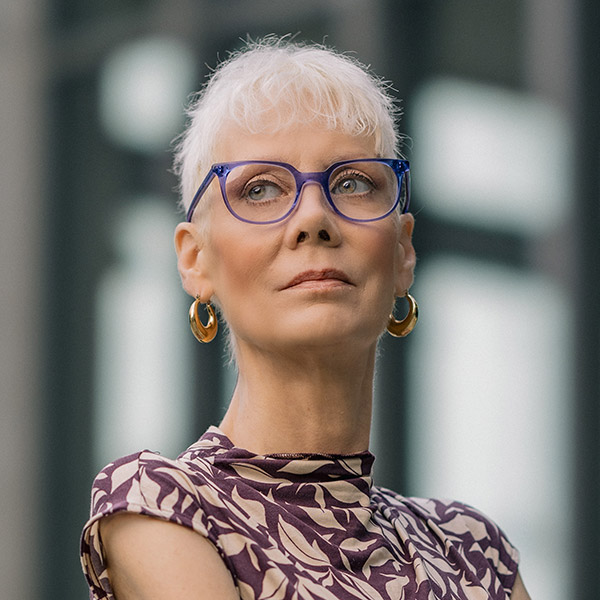
Eve Herold
Editor-in-Chief
Welcome to the first Healthspan Compass of 2026! 2025 was a stellar year for the Healthspan Action Coalition, and we’re deeply grateful to our members, associates and colleagues for helping us make important strides in our mission to end common age-related conditions and extend the global healthspan. That’s a tall order, but a journey of a thousand miles takes place step by step. See below for just a few of the highlights of HSAC accomplishments and activities in 2025. Then read on for news and perspective about a new technology that takes cardiac stem cell implants to the next level, a breakthrough on reversing Alzheimer’s disease, and the widespread embrace of synthetic biology.
HSAC 2025 Milestones: 300 Members, New Alliances and an Expanded Public Education Outreach
Science doesn’t move forward without critical partnerships among scientists, government, legislators, patient advocates and industry, and this is where HSAC comes in. The year entailed major cuts to government funding and much uncertainty about the future of research in the U.S., but significant progress continues to be made in the longevity and healthspan fields, and HSAC didn’t miss a beat in making numerous advances over a busy year.
We’re thrilled to report that our membership continues to climb at a rapid rate, adding up to a current 300 organizations spanning biotech companies, research labs, patient advocacy groups, key governmental funders and the entire healthspan ecosystem. We’re delighted that this year eight of our member organizations attained semifinalist status with XPRIZE Healthspan, and three are in the top 40! For a complete listing of our current members—the “coalition” in Healthspan Action Coalition—visit our website.
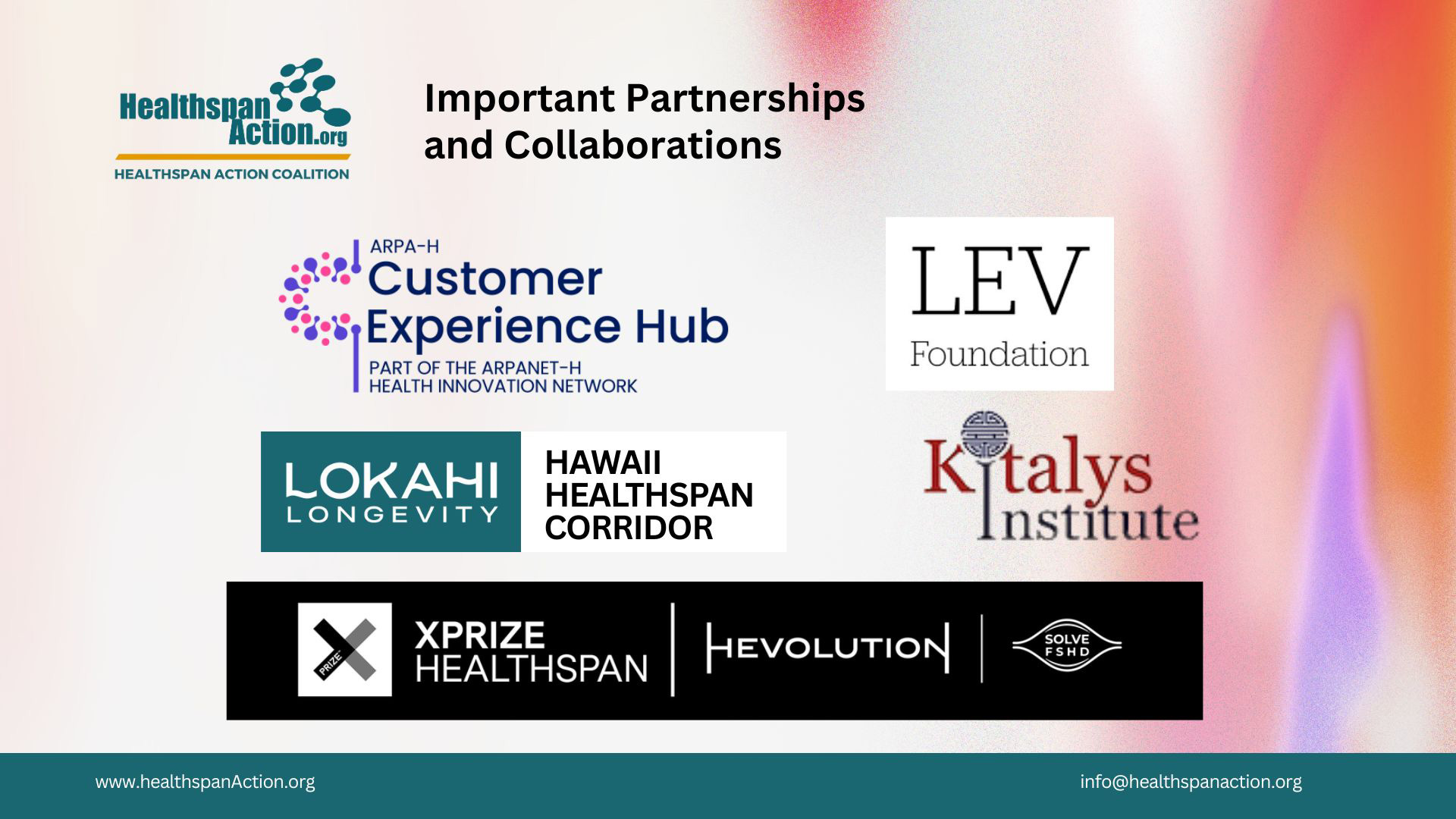
We forged important partnerships and collaborations in 2025 with XPRIZE Healthspan, Research!America and the ARPA-H Customer Experience Hub, all working to advance medical research and healthspan. One of our most exciting partnerships has been with Kitalys Institute, a groundbreaking policy think tank for fostering supportive regulations for healthspan. We’ve been assisting our colleagues at Kitalys with shaping the first U.S. bill to establish a pathway to FDA approval of healthspan drugs, foods, and supplements, called the THRIVE Act. We also worked with Lokahi Longevity and the state of Hawaii to establish the Hawaii Healthspan Corridor, which aims to provide a strong financial and regulatory foundation for promoting healthspan in the beautiful state of Hawaii and beyond. This is just the tip of the iceberg of HSAC partnerships, with many more in the works for 2026.
One of the pillars of our mission is continuously educating the healthspan community and the general public about important longevity and healthspan research and the pressing need to support it at every level. In 2025, HSAC launched a new podcast, The Healthspan Compass Podcast. Our talented hosts, including entrepreneur and investor Junaid Mian, RPH, stem cell expert and founder of Hoya Consulting Heather Main, PhD, and cardiologist and founder of Well12 Sanjay Bhoraj, MD, plumb the depths of new advances in regenerative medicine and healthspan with some of the field’s leading scientists and advocates. HSAC Executive Director and co-founder Bernard Siegel and Chief Operating Officer and co-founder Melissa King also interview experts and provide deep insight for the series. At the same time, Siegel, King and author and Director of Policy Research and Education Eve Herold continue to provide interviews for other podcasts and publications, all of which are posted on the website.
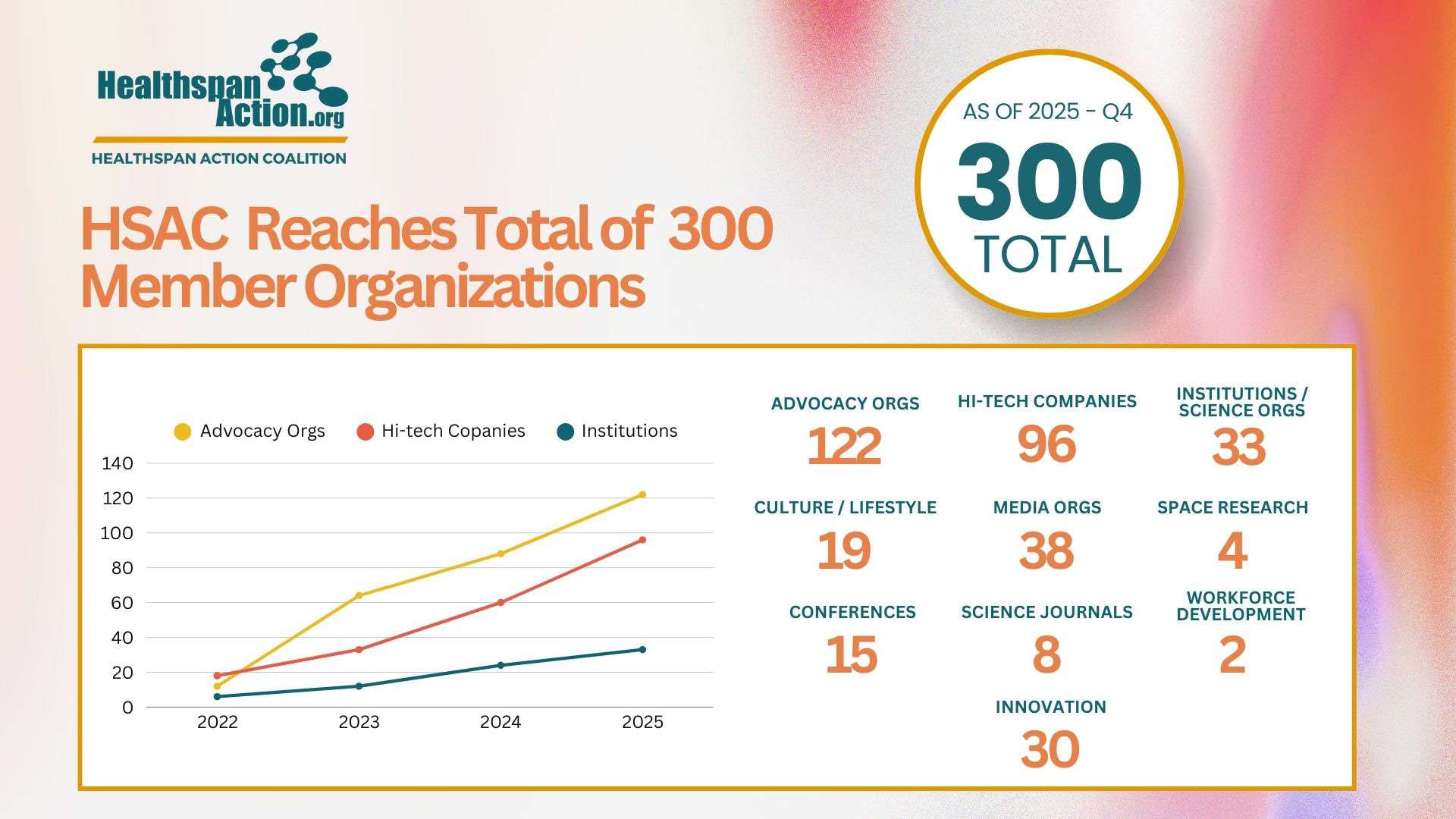
Image Caption: Graph above is Healthspan Action Coalition’s current membership level as of Fourth Quartier of 2025
HSAC continued to promote meetings and events related to longevity and healthspan worldwide, while Bernard Siegel and Melissa King spoke at many of them. Important meetings for 2025 included the Dublin Longevity Summit and the Human Rights in the Americas Symposium hosted by the University of Miami, where King brushed up on programs and pathways to advance our mission of establishing healthspan as a universal human right. We continue to leverage a combined experience of over 50 years in regenerative medicine and healthspan advocacy and to accumulate tools and partnerships to catalyze the field and speed the development of cures for longevity and age-related conditions, including tackling the aging process itself.

Extending the global healthspan is a big challenge, and it couldn’t be done without the collective knowledge, experience and talent we draw upon from our members. We’ve built a powerful network that includes the voices of scientists, patients and their advocates, policy experts, biotech companies and health organizations. HSAC conveys its thanks to all of our members while we look forward to an exciting year ahead that abounds with opportunities to advance the field of healthspan.

Novel Approach in Alzheimer’s Reverses Brain Damage
Just imagine what aging would look like if we could not only delay the progression of Alzheimer’s disease but stop it in its tracks and reverse damage to the brain. Well, now it’s been done in mice, challenging the long-held belief that the disease’s ravages cannot be reversed. A new drug, called P7C3-A20, safely boosts NAD+, a key energy molecule that researchers at University Hospitals Cleveland Medical Center, Case Western Reserve University and the Louis Stokes Cleveland VA Medical Center found to be severely depleted in Alzheimer’s disease. The groundbreaking study, led by, Kalyani Chaubey, appears in Cell Reports Medicine.
Using two different mouse models, the researchers found that while NAD+ normally declines with age, the molecule is dramatically depleted in brains affected by Alzheimer’s. Given the new drug, the mice didn’t just improve or delay the progression of the disease, they repaired extensive brain damage and recovered behaviorally. P7C3-A20 not only elevated the levels of NAD+ in the brain, it repaired amyloid and tau pathology and restored energy balance. So why not just take NAD+ supplements? The supplements, according to lead investigator Kalyani Chaubrey, can cause the molecule to build up to toxic levels in the body, hence the importance of finding a drug that restores healthy levels and reverses brain damage. According to this study, that Alzheimer’s holy grail could be found—for mice, at least. Now the race is on to see how P7C3-A20 or a similar drug could potentially reap the same benefits in humans.
Biotech Goes All in on Synthetic Biology
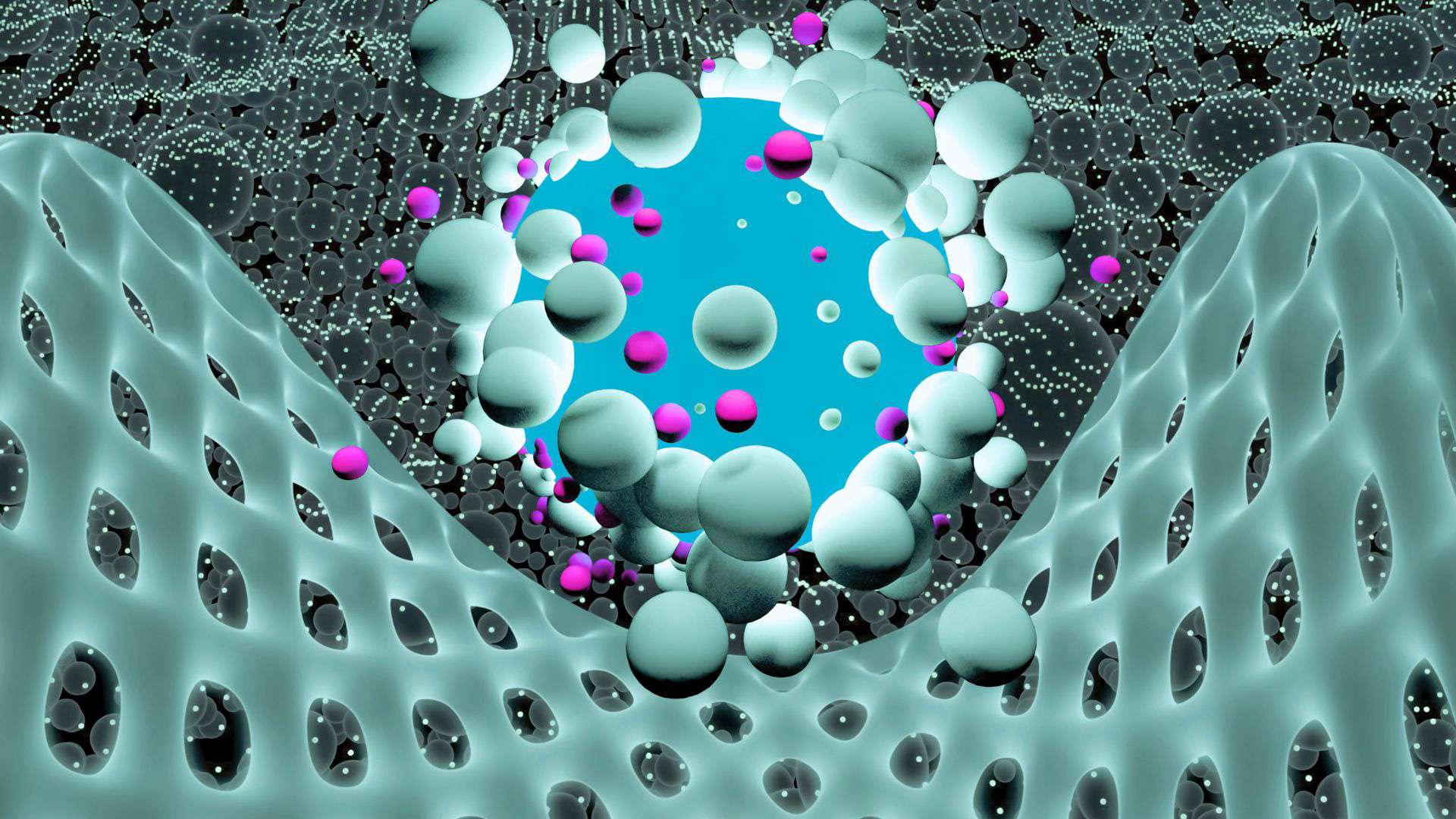
In recent years, a revolution has been spurred through the convergence of technologies that combine engineering, machine learning and robotics with bioscience—a field called synthetic biology. I wrote about artificial medical implants and other medical treatments created by converging technologies in my 2016 book, Beyond Human. Since then, synthetic biology has vaulted into the stratosphere with the application of AI and robotics, CRISPR, engineered drug discovery and programmable medicines, to name just a few applications. The latest issue of Genetic Engineering and Biotechnology News highlights biotech’s embrace of synthetic biology and profiles some of the emerging technologies that accelerate research and compress discovery times for new therapies from months or years to mere weeks.
The GEBN article profiles the work of three biotech companies using synthetic biology. Mammoth Biosciences uses CRISPR techniques with super-small molecules for delivery to hard-to-reach tissues such as those in the brain and the muscles. Mammoth co-founder and CEO Trevor Martin says that the compact CRISPR systems created using machine learning allow for the delivery of more complex gene modifications. Inductive Bio and Gingko Datapoints use software principles applied to designing and testing new small-molecule drugs. Senti Bio is programming “clean” cancer drugs that target cancer cells without the collateral damage to surrounding cells and tissues that plague existing chemotherapy drugs. These programmed drugs are able to distinguish between healthy cells and cancer and “decide” to only attack the sick cells.
Where will synthetic biology take us next? We’ve only scratched the surface of what these technologies can do while significantly reducing the cost of research and dramatically speeding the pace of discovery. Expect to see a profusion of new therapies emerging at a speed that until a short time ago would have been unthinkable, while a plethora of effective therapies promise to wend their way to human treatments.
Help Change the World by Supporting Our Mission
We believe that healthy longevity is a pressing need and a global human right. You can become a part of the Healthspan Action Coalition’s dedication to prolonging the healthy, vital years of life by clicking on one of the donation buttons below and giving. Thank you for being a part of our quest to end age-related disabilities and add not just years to life, but life to years!
MAKE A DONATION
Healthspan Action Coalition is a non-profit organization, granted tax-exempt status under Section 501(c)(3) of the United States Internal Revenue Code. Contributions are tax-deductible to the extent allowable by law.